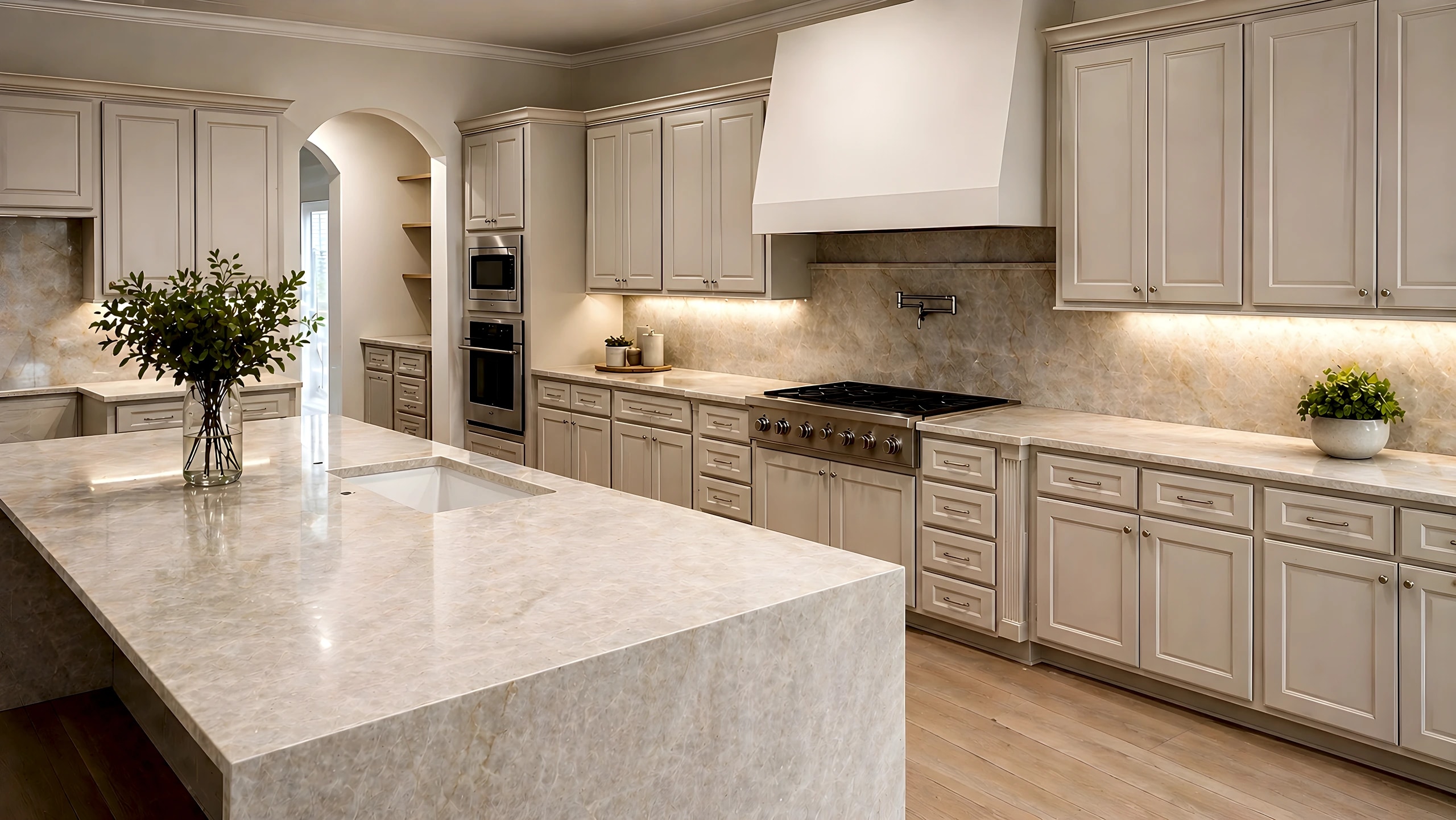
Cabinet painting vs replacement.
The single highest-leverage decision in a kitchen project. Get it right and you save $15,000. Get it wrong and you spend $9,000 on cabinets that fail in two years.
The short answer
Refinish if the cabinet boxes are structurally sound, the layout works for you, and you like the door style. Replace ifthe boxes are particleboard with water damage, the layout doesn’t work, or you want a door style change.
Refinish is $3,500 to $9,000 (5 to 8 on site). New custom cabinets for the same kitchen run $20,000-$45,000+. The math heavily favors refinish when the structural test passes.
The structural test
Run this five-minute check on your kitchen before deciding:
1. Open and close every door
Doors should swing freely without binding, sagging, or rubbing the cabinet next to them. A door that drops out of alignment is usually a hinge issue (cheap fix). A door that’s warped or splitting at the panel is a door replacement (medium fix). Hinges and doors aren’t reasons to replace boxes.
2. Pull out every drawer
Slides should glide. Boxes should be square. If the drawer box is falling apart at the corners (stapled MDF that’s come unstuck), the drawer needs replacing — but the cabinet itself is probably fine. If the drawer face is loose from the box, that’s a hardware fix.
3. Check the cabinet under the sink
This is the make-or-break test. Pull out everything in the under-sink cabinet and look at the floor of it. If the bottom is swollen, soft, discolored, or the laminate is peeling — that cabinet has had a leak. If the boxes are particleboard or MDF, water damage means box replacement. If the boxes are plywood, light damage can sometimes be cleaned up; bad damage still means replacement.
4. Look at the cabinet sides where they meet the wall
Press on the side panels. Plywood feels solid. Particleboard or MDF feels denser but can have soft spots near edges. Particleboard cabinets that have been wet, even briefly, will often have a soft, swollen edge somewhere — that’s a structural concern.
5. Stand back and ask: do I like the layout?
If the layout works — sink in the right place, fridge in the right place, enough counter on either side of the cooktop — refinish makes sense. If you’re going to want to move things, replace.
When refinish is the right call
- The boxes are plywood (any age) or particleboard with no water damage
- You like the layout
- You like the door style or it’s neutral enough to not bother you
- The hinges and slides work or are an easy upgrade
- You want a different color but not a different kitchen
- Your budget is under $15k for the cabinet portion
When replacement is the right call
- Particleboard or MDF boxes with any water damage
- You hate the door style (raised panel and you want shaker, etc.)
- You want to change the layout — move the sink, add an island, take down a wall
- Multiple cabinets are out of plumb because the boxes are warped
- You want soft-close on every door and drawer and the existing cabinets won’t take retrofit hardware cleanly
- You’re upgrading to inset doors (not possible to retrofit cleanly)
The hybrid path: replace some, refinish the rest
Sometimes the right answer is partial. Common scenarios we run:
- Replace the sink cabinet (water damaged) and refinish everything else. Match the new cabinet’s door style to the existing.
- Build out a new island in the same style, refinish the perimeter cabinets.
- Replace the upper cabinets with custom (different style — open shelving, glass front, etc.), refinish the base cabinets in a complementary color.
The hybrid path requires a contractor who’s comfortable matching new construction to existing — not all are. Our cabinet shop builds doors and face frames to match existing profiles when this is the right move.
What “refinishing” actually means
The word “refinishing” is unfortunately diluted in the market. Some shops are using wall paint with a brush. We’re using sprayed industrial enamel after a documented prep and primer process. The price difference reflects that.
See our cabinet refinishing page for the full process and the materials we use.
Not sure which way to go?
Book a free in-home visit. We'll look at your cabinets, run the structural test, and tell you honestly whether refinish or replace makes sense for your project.
Free in-home estimates in The Woodlands area. For projects outside that area, a travel fee applies.